Search


 English
 中文简体
 русский
 عربى


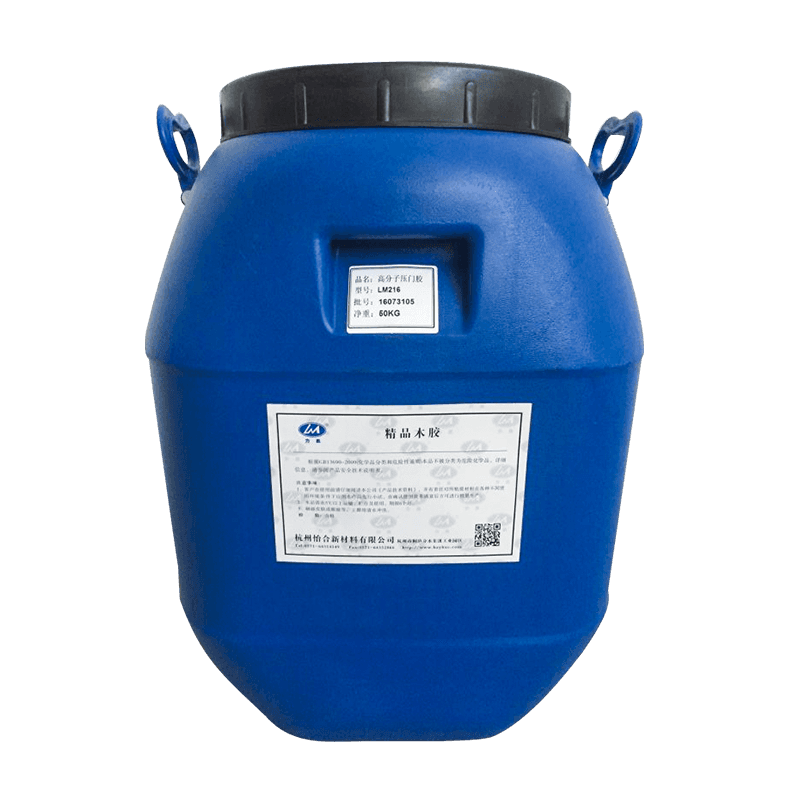



Hangzhou Yihe New Materials Co., Ltd. has formulated specialty adhesives for wood door manufacturing since 1997, first as the Tonglu Lima specialty adhesive factory and today as a supplier of eco-friendly adhesives working from Tonglu beside the Fuchun River. Our High-Polymer WPC Lamination Adhesive For Wood Doors is the grade developed for bonding wood-plastic composite panels and decorative skins to wood board cores, where the joint must hold through humidity and temperature cycling without cracking, warping or lifting at the edges.
Around that grade sits the wider Premium Woodworking Adhesive, together with our water-based PVC lamination and vacuum thermoforming ranges that dress the same door blanks in film. Door plants take the whole lay-up from one source: WPC board lamination, veneer and laminate skins, panel joints and tenon assembly.
What the High-Polymer WPC Lamination Adhesive For Wood Doors Is Built To Do
The formulation targets the specific weakness of WPC door construction: a wood-fibre and polymer core that expands and contracts at a different rate from the skin bonded to it. When the adhesive cannot absorb that movement, the result shows up as surface cracking, panel warping or a delaminated edge on a finished door slab.
- Bond strength that carries structural load across the full panel face, not only at the perimeter.
- Compatibility across WPC panels and wood boards supplied by different mills, so a change of panel batch does not force a change of adhesive.
- Resistance to moisture and temperature fluctuation, which is where door panels in service most often fail.
- Fast cure and strong initial tack, so skins can be positioned accurately and released from the press without slip or edge lift.
- Low-odour, low-VOC chemistry developed against the limits set in GB 18583-2008 and GB 33372-2020.
Where It Fits in Door Construction
Lamination of a WPC facing or decorative skin to a wood board core is normally the first bonding step in the door build, and everything downstream inherits its flatness. The grade suits flush door slabs, moulded and routed panel doors, and door blanks that are later edge-banded, trimmed or drilled.
- WPC panel to wood board core — the primary use, on flat presses and membrane presses.
- WPC to WPC where a door build stacks composite layers for thickness or rigidity.
- Decorative skin onto a WPC substrate where the outer face is a laminate or film rather than raw composite.
- Interior and exterior door panels, subject to confirming the service environment against the grade selected.
Matching the Grade to the Door Build
A door is several bonds, not one. The table below shows how the wood door range divides by function, so a single enquiry can be quoted as a complete adhesive set rather than one drum of glue.
| Product | Door application | Where it earns its place |
|---|---|---|
| LM216 High-Polymer Board Lamination Specialty Adhesive | WPC panels and skins bonded to wood board cores in flush and moulded door slabs | High initial tack for positioning, fast cure for short press cycles, tolerance of core movement |
| Premium Wood Veneer Adhesive | Real veneer faces on solid wood and lacquered door surfaces | Natural-wood door faces where the skin is thin and shows every bond-line defect |
| Premium Laminate Adhesive | Decorative laminate bonded to door cores and blanks | High-pressure decorative faces on internal and contract door blanks |
| Wood Panel Joint Adhesive | Core build-up and edge joints in door blanks | Joint strength before any skin is applied, so the blank stays flat through lamination |
| Tenon Joint Assembly Adhesive | Stile-and-rail frames and mortise-and-tenon door construction | Frame assembly that has to stay square while the slab is pressed and finished |
| Water-Based PVC Lamination Adhesive Series | PVC film on MDF door skins and flat door panels | Where the door face is film rather than WPC, with low odour on the line |
| Liquid PUR and PUR Hot Melt | Flat lamination of film and veneer on door blanks | Solvent-free 100% solids bonding at low coat weight where the line supports reactive chemistry |
Critical Specifications We Fix Before Shipment
Adhesive performance on a door line is a set of numbers that have to agree with each other. We lock the following against your process rather than issuing a generic datasheet and leaving the line to find the working point.
- Viscosity and solids matched to the applicator — roller coater, spray or hand lay-up — so spread stays even across a full door width.
- Recommended wet coat weight for the substrate pair, balancing bond strength against drying load and glue-line show-through.
- Open time against the time between coating and press closing, including transfer and positioning.
- Press envelope — temperature, pressure and dwell — for the press type you run.
- Green strength and handling time before the slab can be trimmed, edged or stacked.
- Full cure and post-press hold before machining, so edge defects do not appear after the door is finished.
Working With Your Line: Application, Press and Cure
WPC door lamination is unforgiving of uneven spread. Composite panels vary in density and surface energy between suppliers, and a coat weight that wets one batch may sit on the surface of the next. Our technical support starts from the panel you actually buy, not from a nominal composite.
- Application trials on your own panel and skin combination, run at your line speed and press settings.
- Guidance on surface preparation and on the storage conditions that keep WPC panels dimensionally stable before pressing.
- Adjustment of the formulation where a high-gloss or thin skin is prone to telegraphing the bond line.
- Troubleshooting for edge lift, blistering, warping and post-machining delamination, traced back to coat weight, open time or press profile.
The grade supplied under this category is LM216 High-Polymer Board Lamination Specialty Adhesive, the single product in the range and the starting point for every WPC door lamination enquiry.
Quality Assurance and Acceptance Evidence
Hangzhou Yihe New Materials holds National High-Tech Enterprise qualification and operates under ISO 9001 quality management and ISO 14001 environmental management certification. Our laboratory carries out raw material checks, in-process testing and finished-batch verification before release, and production and inspection equipment are held in-house at the Tonglu site.
- Batch-linked records covering viscosity, solids and appearance at release.
- Bond performance assessed on the substrate pair named in the order, where the customer supplies panels for trial.
- Technical data sheets and safety documentation issued with each grade, including VOC and environmental statements against GB 18583-2008 and GB 33372-2020.
- Certificate copies available for project files, tender submissions and factory audits.
Information We Use to Configure Your Solution
A quotation becomes usable when it carries a grade, a coat weight and a press profile rather than a price per kilogram alone. The inputs below are what our technical team works from.
- Substrate pair — WPC panel type and density, core board species or grade, skin material and thickness.
- Door construction — layer order, slab thickness, whether the panel is routed or moulded after lamination.
- Line data — applicator type, line speed, press type, available temperature and pressure range, cycle time target.
- Service environment — interior or exterior door, climate, humidity exposure, finishing system applied afterwards.
- Defects to solve — cracking, warping, edge lift or surface show-through observed on current production.
- Volume and logistics — monthly consumption, pack size and container configuration, storage conditions on site.
- Compliance requirements — target VOC limits, customer or market standards, documentation needed for acceptance.
Packaging, Delivery and Technical Response
We agree pack size, container configuration and pallet pattern against the handling equipment at your plant, and label shipments so that batch identity stays traceable through your incoming inspection. Storage and shelf-life conditions are stated on the technical data sheet, and stock rotation follows the batch date.
Technical support continues after delivery: process questions, defect analysis and re-trials on changed panels are handled by the same team that set the original working point, and formulation adjustments are made in our own laboratory rather than outsourced.
Frequently Asked Questions
Which substrates does this WPC door lamination adhesive bond?
It is formulated for bonding wood-plastic composite panels and decorative skins to wood board cores, and for WPC-to-WPC lay-ups. It is compatible with the range of WPC panels and wood boards used in door manufacturing; we confirm the exact pair against samples of the panel you buy.
Can it be used for exterior door panels?
The cured bond is built to resist moisture and temperature fluctuation, which allows the grade to serve exterior as well as interior door panels. Because exterior service conditions differ by market, we review the climate, the finishing system and the panel build before confirming the recommendation.
How do you set the press cycle and coat weight?
From your press type, line speed and panel build. We start with the recommended coat weight for the substrate pair, then adjust temperature, pressure and dwell until the slab releases flat with no edge lift and no show-through. The agreed settings are documented for the grade supplied.
What if our door face is PVC film rather than a WPC panel?
Then the water-based PVC lamination and vacuum thermoforming ranges are the correct starting point, not this grade. Many door plants run both, and we quote them together so the film and composite lines share a single technical contact.
What documentation is supplied with an order?
Each shipment carries the technical data sheet, batch identification and safety information, with VOC and environmental statements against GB 18583-2008 and GB 33372-2020. ISO 9001 and ISO 14001 certificate copies are issued for project files and audits on request.
How do I get a quotation for the High-Polymer WPC Lamination Adhesive For Wood Doors manufacturer grade?
Send the substrate pair, door construction, line data and monthly volume. Our team returns a grade recommendation with coat weight, press guidance and a quotation based on the pack and delivery configuration you specify.