 Search


 English
 中文简体
 русский
 عربى


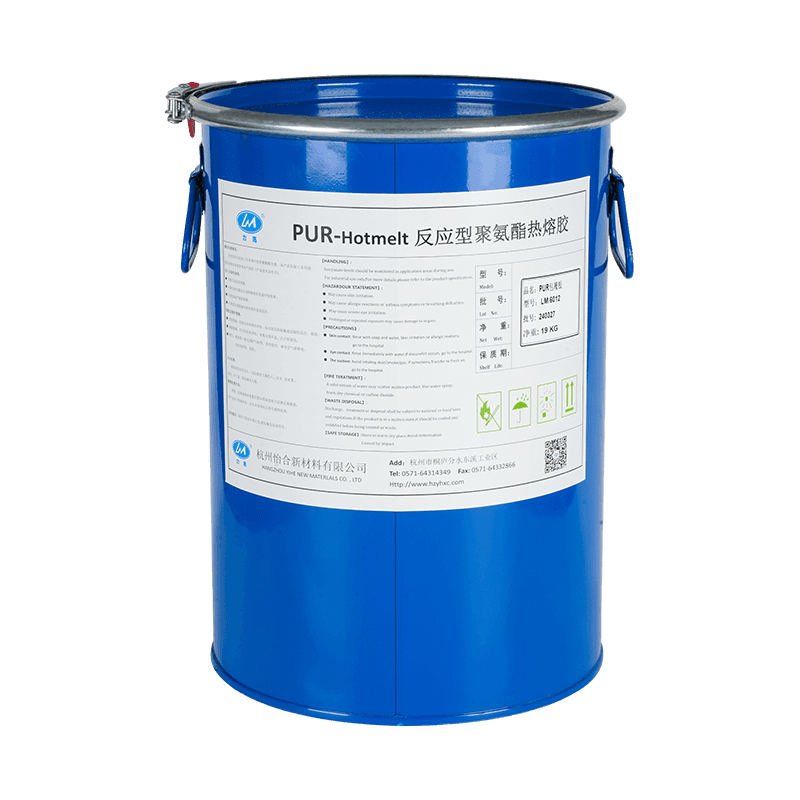



Hangzhou Yihe New Materials Co., Ltd. has formulated adhesives in Tonglu, Hangzhou, since 1997. Within our PUR Hot Melt Adhesive Series we act as a PUR Wrapping Hot Melt Adhesive manufacturer, supplying profile wrapping lines that bond decorative film, paper and veneer to MDF, particleboard, WPC and engineered wood profiles. The products are built for plants running continuous wrapping, where bond strength, surface appearance and cycle time have to hold together across a full shift.
Wrapping puts an adhesive into a thin, exposed joint. The bond is asked to survive trimming, machining, heat and handling within seconds of leaving the nip, then to keep holding for the life of the component. A reactive PUR system answers that combination because it goes down as a 100% solids melt, gains handling strength as it cools, and then crosslinks with ambient moisture into a thermoset that will not re-melt in a warm warehouse or a closed cabinet.
Range at a glance: LM6012 General PUR Wrapping Hot Melt Adhesive - one-component, solvent-free, moisture-curing polyurethane with 100% solids, formulated for high-speed wrapping of wood chips and engineered boards.
What the Adhesive Has to Do on a Wrapping Line
A wrapping line carries a machined profile past an application head, lays a preheated film or veneer into the adhesive bead, and closes the joint under nip rollers before trimming. Everything the adhesive does happens inside those few metres: it must wet the substrate, hold the film against spring-back, flow out under the nip, and not string or drip on the return path.
- Wet-out on machined wood. MDF and particleboard cut faces vary in density and dust load, even within one press; the melt needs enough flow to penetrate rather than sit on the surface.
- Green strength within seconds. Wrapped profiles usually travel to trimming and handling before cure is complete, so early strength has to come from cooling.
- Creep resistance after cure. A crosslinked PUR bond resists the sustained peel load of a stretched film at the profile radius, which is where thin, high-stress wraps fail first.
- Clean appearance. No glue-line read-through on thin veneer, no haze beneath high-gloss PVC, no foam or bubble at the edge.
The Range and Where Each Product Fits
Wrapping is one station within a family of reactive PUR adhesives. Setting the wrapping grade against the rest of the PUR Hot Melt Adhesive Series lets a plant with several bonding stations work from a single chemistry platform and a consistent handling routine.
| Product | Chemistry | Bond and substrate | Where it fits |
|---|---|---|---|
| LM6012 General PUR Wrapping Hot Melt Adhesive | Reactive PUR, one-component, solvent-free, 100% solids | Film, paper and veneer onto wood chips, MDF and engineered boards | Profile wrapping, furniture components, flooring and panel production |
| LM6016 PUR Moisture-Curing Hot Melt Adhesive | Reactive PUR, 100% solids | PVC, PET and acrylic films in flat lamination | Full-surface panel lamination where a press rather than a wrapping head forms the bond |
| LM6019 General PUR Edgebanding Hot Melt Adhesive | Reactive PUR, 100% solids | Edgeband on panel edges | Edgebanding lines that need heat and moisture resistance at the joint |
| LM2260 Cold-Press Liquid PUR Adhesive | Liquid PUR, moisture-curing | Panels and assembled components | Cold-press lamination and assembly where hot melt equipment is not available |
| EVA Wrapping Hot Melt Adhesive | Ethylene vinyl acetate hot melt | Wrapping where service conditions allow a thermoplastic bond | Cost-sensitive profile work with lower heat demands |
LM6012 in Detail
LM6012 is our general-purpose grade for wrapping and covering work. It is a one-component, solvent-free reactive polyurethane hot melt with 100% solids content, so there is no water or solvent carrier to drive off and nothing leaving the melter except the adhesive itself. Cure comes from ambient moisture and continues after the profile has been trimmed, packed or moved to assembly. Full product data for LM6012 General PUR Wrapping Hot Melt Adhesive covers the handling and application details.
- Bonds film, paper and veneer to wood chips and engineered boards, including MDF and particleboard profiles.
- Formulated for high coverage and controlled melt flow, so coat weight stays even across complex profiles with tight radii and open faces.
- Rapid setting supports high-speed production and shortens the distance a wrapped part must travel before it can be handled.
- Runs in automated wrapping heads as well as manual and semi-automatic application, which matters where one plant operates both.
- Typical service areas are furniture manufacturing, flooring production, and panel and profile production.
Substrates, Films and Surface Conditions
Most wrapping defects trace back to what enters the nip rather than to the adhesive alone. Board density, dust, film chemistry and profile geometry all shift the working point, and a grade that performs cleanly on one combination can string or haze on another.
- Board. Freshly machined, dust-extracted faces bond most consistently; dense, closed MDF surfaces need enough melt flow to key in, while open particleboard edges draw adhesive away from the film interface.
- Moisture. Very dry board slows the moisture-driven cure, and board that is too wet risks steam and movement under the nip. Conditioning profiles to a stable moisture level before wrapping keeps the bond repeatable.
- Film. Flexible PVC can release plasticizer that shows as haze beneath high-gloss surfaces; PET and PP have lower surface energy and may need pre-treatment or a higher coat weight; porous paper and CPL absorb adhesive and change the effective open time.
- Geometry. Tight radii and end-grain edges demand more green strength and more edge pressure than flat faces, and thin veneer shows glue-line read-through at heavier coat weights.
Critical Specifications We Set With the Line
A wrapping specification is a working point, not a single number. We fix the following with the customer so that adhesive, melter and line speed describe the same process.
- Melt viscosity at application temperature - controls flow into the grain and film wet-out at the head.
- Open time against head-to-nip distance - the melt must still be tacky when the film lands, and already building strength at the trimming station.
- Green strength - matched to film stiffness and profile radius so the wrap does not spring back.
- Coat weight in g/m2 - the balance between full coverage and read-through, stringing or squeeze-out.
- Heat resistance of the cured bond - set by the final service environment: transport, warehouse or a warm interior.
- Thermal stability in the tank - how long the product tolerates holding temperature without skinning, char or viscosity drift.
Melters, Application Heads and Line Integration
The adhesive is specified against the equipment it will run in: tank or drum-unloading melter, heated hose, and roller, slot-die or nozzle application. We agree the temperature window, refill practice and hose set points with the line engineers so that melt quality at the head stays constant through the shift.
Reactive PUR needs dry, closed handling. Sealed refill and dry-air blanketing keep atmospheric moisture away from the melt surface, where skinning would otherwise carry cured particles into the head. Flow commands are normally tied to line speed so that coat weight stays stable through acceleration and stop-start cycles, and we confirm the head-to-nip distance that matches the grade's open time.
Hot melt work carries standard burn and handling risks: gloves and face protection at the head, no moisture or water near the melt, and ventilation around the application area.
Quality Control and Batch-to-Batch Consistency
Consistency matters more in wrapping than in almost any other bonding operation, because a line is set up once and then run at speed. Small drift in viscosity or open time shows up as changed coat weight, stringing at the cutoff or a loosened edge. Hangzhou Yihe holds National High-Tech Enterprise qualification and operates under ISO 9001 quality and ISO 14001 environmental management systems, with in-house laboratory facilities covering raw-material intake, in-process checks and finished-product testing before release.
Reactive PUR is handled as a moisture-sensitive material throughout production and packing, which is also why container sealing and storage guidance carry real weight on the customer side.
Common Wrapping Defects and the Variables We Adjust
| Symptom | Usual cause | Adjustment |
|---|---|---|
| Haze or spotting under gloss PVC | Plasticizer migration, excess coat weight, porous substrate | Confirm grade compatibility, reduce coat weight, tighten substrate sanding |
| Bubbles or blisters after the nip | Trapped air, low nip pressure, cold film | Raise roller pressure, preheat film, review line speed against open time |
| Edge lift or spring-back at radii | Insufficient green strength for a stiff film | Higher coat weight at the edge, more pressure on the radius, check melter temperature |
| Stringing at cutoff | Melt temperature outside the window, degraded material in the tank | Reset temperatures, drain and clean the melter, check nozzle condition |
| Delamination after heat cycling | Incomplete cure from dry substrate or blocked moisture path | Condition board, review coat weight and cure time before heat exposure |
Information We Use to Configure Your Solution
A proposal is prepared from the working point of the line, not from a generic catalogue number. The inputs below let us match grade, coat weight and handling advice to the process before any material is shipped.
- Substrate: board type, density, thickness, moisture level and surface preparation.
- Wrap material: film or veneer chemistry, thickness, gloss level, pre-treatment and roll width.
- Profile: geometry, radius, wrap angle and exposed end grain.
- Line: speed, head-to-nip distance, melter and application type, temperature set points and target coat weight.
- Service conditions: workshop climate, heat exposure of the finished part, and any heat-cycle or cold-bend requirement.
- Commercial frame: pack size against melter capacity, expected monthly volume, delivery terms and labelling requirements.
Supply, Documentation and Technical Support
Adhesive is manufactured at our site in Dongxi Industrial Park, Tonglu County, Hangzhou, China, and packed in the format agreed at quotation so that handling matches the melter and the storage space available. Each delivery is identified to its production batch, and product data covering handling, storage and application accompanies the shipment for plant registration and operator briefing.
Where a new film, board or profile is being introduced, our laboratory evaluates adhesion on customer-supplied samples and we review the result with the process engineers before a line trial. Support continues through the first production run and through later changes in film supplier, board grade or line speed.
Frequently Asked Questions
What is PUR wrapping hot melt adhesive used for?
It bonds decorative film, paper, CPL and veneer to machined wood profiles such as furniture components, wrapped flooring edges, frames and panel edges, where a thin wrap has to follow a shaped surface and stay tight. LM6012 is the grade in our range dedicated to that work.
Does LM6012 contain solvent or water?
No. LM6012 is a one-component, solvent-free, moisture-curing polyurethane with 100% solids content. Nothing has to evaporate from a carrier before the bond forms, and cure develops from ambient moisture after the wrap has been closed.
How does PUR compare with EVA for wrapping?
EVA hot melt sets by cooling and can be re-softened by heat, which suits many interior profiles at moderate service temperatures. PUR crosslinks, so the cured bond resists heat and creep more strongly and is generally run at lower coat weights; the trade-off is a moisture-driven cure and stricter handling. Both chemistries are available from us, including EVA Wrapping Hot Melt Adhesive.
How should the adhesive be stored and handled?
Keep containers sealed in a dry, moderate-temperature store, because moisture is what cures the product, and do not leave drums or melter lids open to humid air. In the melter, hold the agreed temperature window and avoid topping up with cold product faster than the tank can recover.
Can the adhesive be trialled on our own film and profile?
Yes. Send the board, film and a representative profile section with the line data, and our laboratory will assess adhesion and appearance on that combination before a production trial is scheduled. Results, recommended coat weight and temperature set points are reviewed with your process team.











