 Search


 English
 中文简体
 русский
 عربى


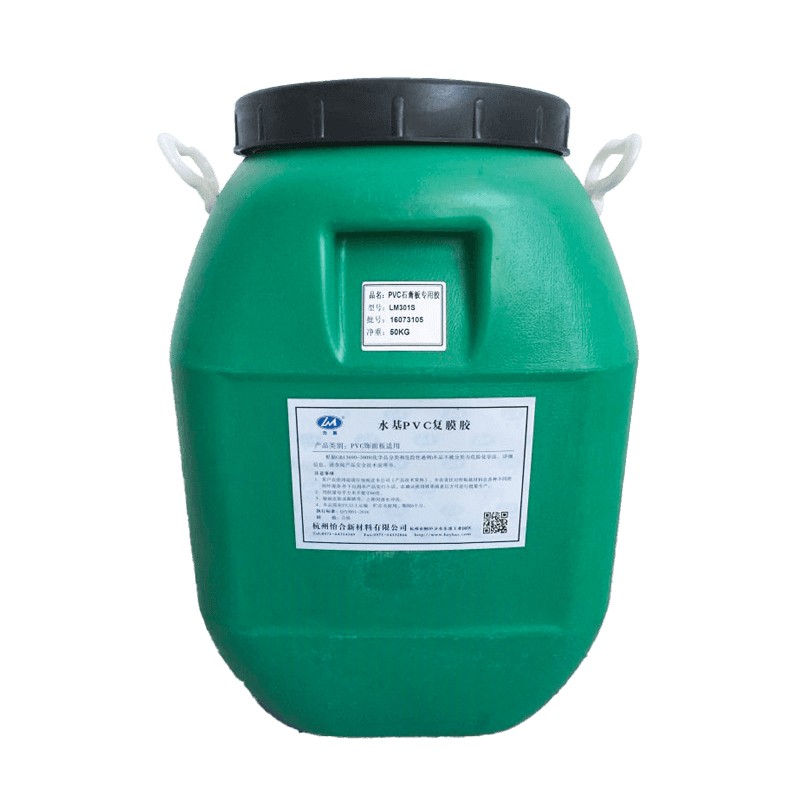
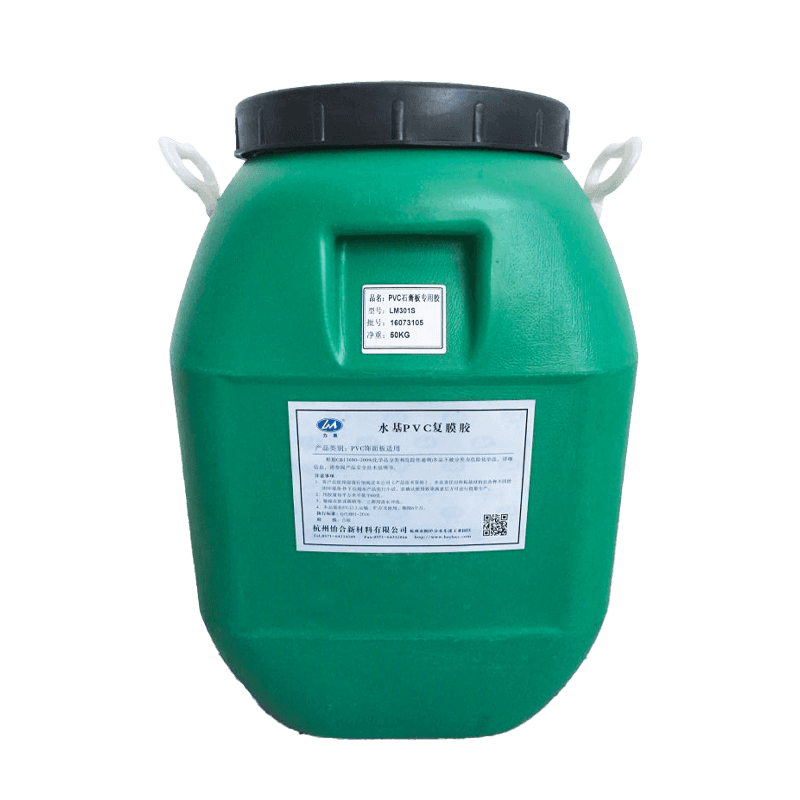



Hangzhou Yihe New Materials Co., Ltd. has formulated water-based adhesives in Tonglu, Hangzhou since 1997. Within our Water-Based PVC Lamination Adhesive, this category covers PVC film lamination onto gypsum board: LM301S for paper-faced board and LM115 for aluminium-coated board. Both are solvent-free dispersions built for ceiling tile, wall cladding and decorative panel production, where a thin PVC skin has to stay locked to a mineral core for the service life of the building.
As a Water-Based Adhesive For Gypsum Board PVC Lamination manufacturer, we work at the point where two difficult surfaces meet. Paper liner wets readily but absorbs water that can soften the gypsum core; aluminium foil is non-porous and gives the adhesive almost nothing to key into. The two grades are formulated around that difference rather than around a single general-purpose formula.
Product Range for Gypsum Board PVC Lamination
LM301S and LM115 share the same water-based polymer dispersion platform and differ in how they manage the face they bond to. Both are supplied as ready-to-use liquids, applied by roll coater, curtain or spray according to the line, and dried before the PVC film is nipped to the board.
| Grade | Face to be bonded | Typical panel use | Formulation emphasis |
|---|---|---|---|
| LM301S PVC Paper-Faced Gypsum Board Adhesive | PVC film on paper-faced gypsum board | Ceiling tiles, wall cladding, decorative board | Anchoring to the paper liner, controlled water release to limit core soak, flat lay after stacking |
| LM115 Aluminum-Coated Gypsum Board Adhesive | PVC film on aluminium-coated gypsum board | Foil-faced ceiling tiles, moisture-resistant panels, cleanroom and corridor cladding | Wet-out on a non-absorbent foil, adhesion through a low-absorption face, blister and edge-lift control |
How the Bond Forms on a Lamination Line
Water-based lamination is a drying process as much as a bonding process. Adhesive is metered onto the PVC film or onto the board face, water is driven off in the drying section, and the film is married to the board at the nip while the polymer can still flow. Strength develops as the film cools and the last of the water leaves the glue line.
- Coating head. Smooth-roll or reverse-roll application gives the most even film on thin PVC; spray is used where the board face is coated directly and edges need to stay clean.
- Drying. Air velocity and zone temperature matter more than peak heat. The aim is a tacky, mobile adhesive film at the nip, not a dry skin.
- Nip. Pressure and roll temperature set contact and squeeze-out; on foil-faced board the nip also decides whether air is trapped under the film.
- Stacking. Boards are stacked warm and flat so residual moisture can equalise without curling the panel.
On gypsum substrates the water balance is the controlling variable. Under-drying leaves water to migrate into the core, softening the board and encouraging curl; over-drying skins the adhesive before the nip and costs peel strength. We set the drying and nip window against your board weight, film gauge and line speed, because those three move the working point.
Substrate Behaviour: Paper Liner Versus Foil
Paper-faced gypsum board
The bond is only as good as the paper. A well-formed joint tears fibres out of the liner when peeled, which shows the adhesive has penetrated the paper rather than sitting on the surface. Liner sizing, recycled content and surface dust vary between board makers, and each changes how much adhesive is needed and how fast water passes into the core. LM301S is formulated to wet the liner quickly at low coat weight, so the gypsum core sees as little water as possible.
Aluminium-coated gypsum board
Foil-faced board offers no absorption and very little mechanical key. Adhesion depends on complete wet-out of the metal surface, a flexible adhesive film that follows the foil through handling and cutting, and a nip that excludes air. Blisters, edge lift and foil wrinkling are the usual failure signatures, and they are process problems as often as formulation problems. LM115 is built for a slower, fuller wet-out and a tougher dried film than a paper-grade adhesive would give on the same line.
Critical Specifications We Control and Report
Every grade is released against a specification agreed with the customer, and the certificate of analysis travels with the batch. The values we hold closest are the ones that change how the adhesive behaves in the coating head:
- Solids content and density — they fix the wet coat weight a given roll gap will deliver.
- Viscosity at a stated temperature and spindle — pickup, levelling and resistance to sag on vertical faces.
- pH — dispersion stability and tolerance of the alkaline gypsum core.
- Appearance and odour — no grit or agglomerate that can print through a thin PVC film.
- Volatile content — water is the carrier; no organic solvent is added to the formulation.
Acceptance and Verification
Trials are run on your board, your film and your line, and the result is judged against a short acceptance list agreed before the run starts. A typical programme covers the checks in the table.
| Check | Method | What we look for |
|---|---|---|
| Incoming adhesive | Viscosity, solids, pH, appearance against the approved specification | Conformance before the drum is opened on the line |
| Peel strength | 180 degree peel of PVC film from laminated board | The bond value agreed for that board and film combination |
| Fibre tear (LM301S) | Manual peel inspection of the failed surface | Paper fibres pulled from the liner rather than clean release |
| Foil adhesion (LM115) | Peel at edges, corners and field of the panel | No lift at cut edges and no blister under the film |
| Ageing | Heat and humidity exposure of laminated samples | Bond retention and flatness after conditioning |
| Appearance | Visual inspection under raking light | No blister, haze or plasticiser bloom through the film |
Quality Assurance and Compliance Documentation
Hangzhou Yihe New Materials holds National High-Tech Enterprise qualification and operates under ISO 9001 quality management and ISO 14001 environmental management certification. Our laboratory and inspection equipment support raw material checks, in-process controls and finished-batch release, with retained samples kept for traceability back to the production record.
Documentation follows the shipment: technical data sheet, safety data sheet, certificate of analysis with batch number, and the test reports applicable to the destination market, including volatile organic compound limits for adhesives where these are requested. The exact document set and the compliance route are confirmed when the specification is agreed, so that the paperwork matches the market the panels are sold into.
Information We Use to Configure Your Solution
- Board: paper-faced or aluminium-coated, board thickness and weight, liner or foil construction, board maker if already fixed.
- Film: PVC gauge, gloss or matte finish, whether plasticiser migration has caused haze before.
- Line: coating method, film-side or board-side application, dryer type and length, nip arrangement, line speed range.
- Target: required peel value, panel flatness tolerance, stacking and handling practice, any post-forming or cutting step.
- Conditions: workshop temperature and humidity, storage conditions, expected shelf time before use.
- Commercial frame: pack size, monthly quantity, destination port, labelling and document requirements.
With that information we return a grade recommendation, an indicative coat weight and drying window, a trial plan with acceptance criteria, and a quotation in the pack format your line can handle. Where the board or film is new to the market, we ask for samples and run the evaluation before a first order is placed.
Packaging, Delivery and Technical Support
Both grades ship in sealed pails, drums and intermediate bulk containers, labelled with product code, batch number and production date. Water-based dispersions are sensitive to freezing and to long exposure to high heat, so storage guidance and shelf life are stated on the data sheet and repeated on the delivery documents. Containers are closed and palletised for container loading, and we agree the shipping mark and documentation set with each order.
Our technical service team supports grade selection, trial supervision and fault diagnosis during start-up. When a line shows edge lift, blistering or curl, we work from the process record first — coat weight, dryer settings, nip, stacking — before recommending any change to the adhesive, because most lamination faults on gypsum board start in the water balance rather than in the formulation.
Frequently Asked Questions
Which grade fits paper-faced and which fits aluminium-coated board?
LM301S is intended for PVC film on paper-faced gypsum board, where the adhesive has to penetrate the liner and anchor into the paper. LM115 is intended for aluminium-coated board, where the face is non-porous and the bond depends on full wet-out and a flexible dried film. Running the paper grade on foil usually shows up as edge lift or blistering within a shift.
Can both products run on our existing roll coater and laminator?
Yes, in most configurations. They are ready-to-use liquids, applied with smooth-roll or reverse-roll coating, curtain or spray, and dried in the line's existing oven before nipping. What we adjust is the working point: coat weight, dryer profile, nip pressure and stack temperature. We confirm the settings against your line data before the trial.
How do we know the adhesive has bonded properly to a paper liner?
Peel a strip of film from a cooled panel. A correct bond tears fibres from the liner and leaves a roughened, fibrous surface. A clean release with a glossy paper face indicates the adhesive sat on the surface, usually because the coat weight was too low or the film was over-dried before the nip.
What causes blistering on foil-faced panels?
Air or water vapour trapped between the film and the foil. Common sources are incomplete wet-out of the aluminium surface, insufficient nip pressure, too much residual water entering the nip, or film fed with slack. We check the coating and nip record first, then review whether the grade matches the foil thickness being run.
How should the adhesive be stored before use?
Keep containers closed and store between the temperatures stated on the data sheet, protected from frost and direct sun. Stir thoroughly before charging the coater, and use stock in production-date order. Shelf life is measured from the production date printed on the label and repeated on the certificate of analysis.
What does a trial require from our side?
Board samples, the PVC film in production gauge, a short run on the actual line and one operator who knows the current settings. We bring the recommended grade, a proposed coat weight and drying window, and the acceptance list. The outcome is a written setting sheet and, where needed, a slightly adjusted formulation for the next batch.











