English
 中文简体
中文简体 русский
 عربى
عربىNews
Home / News / Industry News / Water-Based Adhesive for Gypsum Board PVC Lamination: A Practical Buyer's and User's Guide
 Search
 +86 178 5710 2305

Content
Water-based adhesive for gypsum board PVC lamination is a specialized bonding agent formulated to permanently bond polyvinyl chloride decorative film onto the face of gypsum board panels — commonly known as drywall, plasterboard, or gypsum ceiling tile. Unlike solvent-based adhesives that use chemical solvents as their carrier, water-based lamination adhesives use water as the primary solvent medium, which allows the adhesive polymer to be dispersed in liquid form for easy application and then cure as the water evaporates, leaving behind a strong, flexible polymer bond between the PVC film and the gypsum substrate.
This category of adhesive has become the dominant choice in industrial PVC-laminated gypsum board production for a combination of practical and regulatory reasons. Water-based formulations are significantly safer to handle than solvent-based alternatives — they produce no flammable vapors, generate far lower VOC (volatile organic compound) emissions during application and drying, and are non-hazardous under standard transportation and storage regulations. As environmental and indoor air quality standards have tightened across building product manufacturing in Europe, North America, and increasingly in Asia, the transition from solvent-based to water-based PVC lamination adhesives has accelerated sharply across the industry.
Understanding the basic chemistry of water-based adhesives helps explain why different formulations behave differently on gypsum board substrates and which polymer base is most appropriate for a given production requirement. Most water-based adhesives used in PVC film lamination on gypsum board fall into one of three polymer systems:
PVAc emulsions — essentially a more sophisticated form of standard white wood glue — are among the most widely used base polymers in water-based lamination adhesives. Modified PVAc formulations with plasticizers and tackifying resins offer good initial tack, fast water release, and strong bond strength to porous substrates like gypsum board face paper. Their main limitation is moisture sensitivity: unmodified PVAc bonds soften and lose strength when exposed to high humidity or direct water contact, making them unsuitable for laminated gypsum panels destined for wet or humid environments without additional waterproofing in the formulation.
Acrylic polymer emulsions offer superior water resistance, UV stability, and flexibility compared to PVAc systems. Acrylic-based water-soluble adhesives for PVC lamination bond effectively to both the gypsum board substrate and the back surface of PVC film, and the cured bond retains good flexibility across a wide temperature range — important for panels that will experience thermal cycling in exterior-adjacent or HVAC-exposed applications. Acrylic formulations are also more compatible with non-porous or low-porosity PVC film backing surfaces, where PVAc adhesives sometimes struggle to achieve adequate open adhesion before the film is pressed.
Waterborne polyurethane dispersion adhesives represent the highest-performance tier in water-based PVC lamination adhesives. PUD formulations deliver outstanding bond strength, excellent flexibility, strong resistance to heat and moisture, and superior adhesion to difficult low-surface-energy substrates. They are used in demanding applications — high-humidity ceiling panels, laminated gypsum boards for bathrooms and kitchens, and any product specification requiring compliance with premium bond strength testing standards. The trade-off is higher cost compared to PVAc and acrylic systems, and slower open time that requires careful management in high-speed lamination lines.
To select and apply the right water-based lamination adhesive, it's useful to understand exactly how the lamination process works at an industrial scale. Most gypsum board PVC lamination is performed on continuous roller lamination lines or flat-bed press systems, and the adhesive application method directly determines which adhesive viscosity, open time, and solids content is appropriate.
In a continuous lamination line, the water-based adhesive is applied to either the gypsum board surface or the back of the PVC film — or both — using a roller coater. The roller transfers a metered, controlled film of adhesive at a precise coat weight, typically between 60 and 120 grams per square meter wet weight depending on the substrate porosity and the adhesive solids content. The coated substrate then passes through a drying section where hot air or infrared heaters evaporate the water carrier, leaving a dry or semi-dry adhesive layer. The PVC film is then pressed onto the adhesive-coated surface by nip rollers under controlled pressure, forming the bond.
For smaller production operations or batch processing of irregular-sized panels, the water-based PVC lamination glue is applied by spray gun or airless spray system. Spray application requires the adhesive to be diluted to a lower viscosity than roller coating — typically 500 to 1500 cps — to achieve an even spray pattern without clogging. Coverage must be carefully controlled to avoid both under-application (which leads to bond failure) and over-application (which causes adhesive bleed through the PVC film or excessively long drying times). Spray-applied adhesive is generally suited to contact bonding processes where both the gypsum board and the PVC film are coated, allowed to flash off, and then pressed together when both surfaces reach the correct tack level.
Flat-bed membrane press systems — commonly used for three-dimensional profiled gypsum ceiling tiles and decorative panels — require an adhesive with longer open time than roller coating processes, since the time between adhesive application and press closure is longer. Water-based adhesives formulated for press lamination typically include retarders that slow water evaporation and extend the working window before the adhesive skins over. The press applies uniform pressure across the panel surface, conforming the PVC film to any surface relief or profiling in the gypsum substrate while the adhesive completes its bond formation under heat and pressure.
Water-based adhesives for gypsum board PVC film lamination vary widely in their technical specifications, and choosing the right product for a specific production line and panel specification requires comparing these parameters carefully. The table below covers the most important specifications and what they mean in practice:
| Parameter | Typical Range | Why It Matters |
| Solid Content (%) | 45–65% | Higher solids mean more adhesive polymer per coat weight, faster drying, and stronger final bond; lower solids require higher coat weights to achieve the same bond strength |
| Viscosity (cps/mPa·s) | 1,000–8,000 cps | Must match the application method; roller coating needs higher viscosity than spray; too low causes sagging and bleed-through, too high causes poor roller transfer and uneven coverage |
| pH Value | 6.5–9.0 | Gypsum board is a slightly alkaline substrate; adhesive pH compatibility prevents chemical reaction at the bond line that can weaken adhesion or cause discoloration |
| Open Time (minutes) | 5–30 minutes | The window between adhesive application and film pressing during which a good bond can be achieved; too short causes dry bond failures, too long causes blocking problems in continuous processes |
| Initial Tack | Medium to high | Determines how firmly the PVC film holds immediately after pressing before the adhesive reaches full cure; critical for preventing film lift or edge curl in early handling |
| Peel Bond Strength (N/25mm) | ≥30 N/25mm (cured) | Measures the force required to peel the PVC film from the gypsum board; higher values indicate more durable bond; critical for panels that will be cut, handled, and transported after lamination |
| Heat Resistance (°C) | 60–90°C | Bond must not soften or release at temperatures the finished panel may reach in storage or end use, including hot summer warehouse conditions and ceiling spaces near HVAC equipment |
| VOC Content (g/L) | <50 g/L | Relevant for both worker safety during production and end-product certification requirements under indoor air quality standards such as LEED, BREEAM, and local building regulations |
Even the highest-quality water-based adhesive for PVC film lamination will fail if it is applied to a poorly prepared gypsum board surface. Gypsum board presents specific surface characteristics that must be understood and managed before lamination begins. The face paper on standard gypsum board is moderately porous and accepts water-based adhesives well, but surface contamination, excessive moisture, or surface damage can all compromise bond quality.
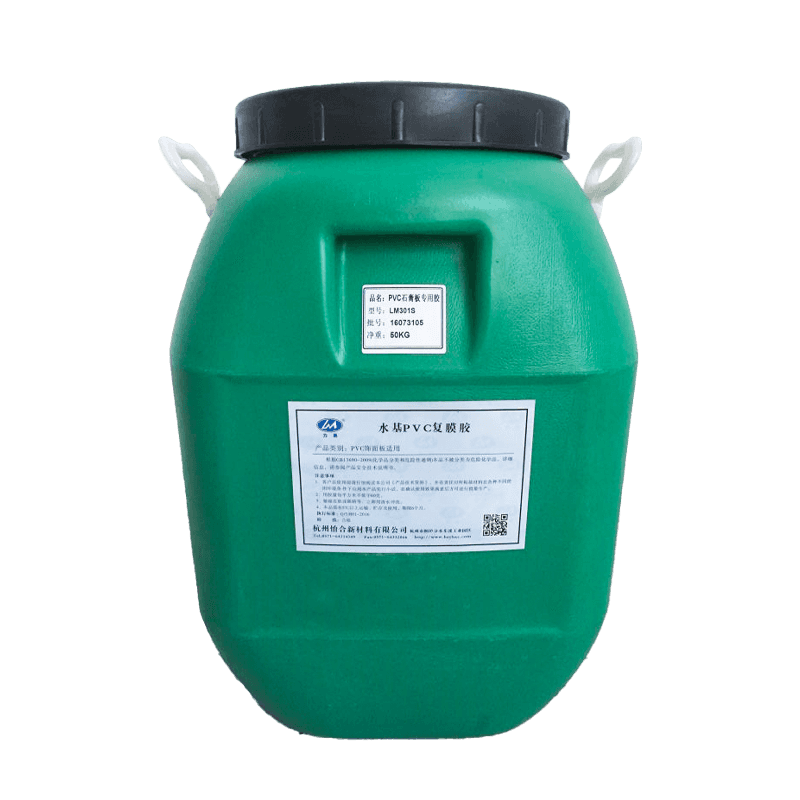
The back surface of the PVC decorative film is as important to bond quality as the gypsum board substrate. PVC film is inherently a low-surface-energy material, which means standard adhesives may not wet out and bond to it effectively without surface treatment or formulation adjustment. Understanding the different back surface configurations used by PVC film manufacturers helps in selecting the correct water-based lamination adhesive formulation.
Some PVC decorative films are supplied with an untreated, smooth back surface. Bonding a water-based adhesive to untreated PVC requires an adhesive formulation with good wetting agents and surface-active additives that allow the adhesive to spread and make intimate contact with the low-energy PVC surface. Without these, the adhesive beads up rather than wetting out, resulting in poor initial contact and weak bond strength after drying. When testing a new water-based adhesive on an untreated PVC film, always run a peel adhesion test on the specific film being laminated — generic bond strength data from the adhesive supplier may be measured on a different substrate and may not reflect real production performance.
Many PVC film manufacturers apply a corona discharge treatment to the back surface of their film during production to raise the surface energy and improve adhesive bonding. Corona-treated PVC film accepts water-based adhesives significantly more readily than untreated film, producing higher initial tack and stronger cured bond strength. The effect of corona treatment degrades over time, however — particularly if the film is stored for more than three to six months after manufacture or exposed to ultraviolet light. When using corona-treated PVC film, confirm the treatment level with the film supplier and check that the film age at the time of lamination is within the effective window of the treatment.
Some PVC films are supplied with a factory-applied back coating — typically an acrylic or PVAc primer — that is specifically designed to provide a receptive surface for water-based adhesives. Pre-coated films are the most straightforward to laminate with water-based adhesives because the surface chemistry is already optimized for bonding. Back-printed PVC films — where a secondary print is applied to the back surface for registration purposes — may have ink coverage on the back surface that creates localized adhesion differences; always test bond strength at both printed and unprinted back surface areas when working with back-printed film.
Even with the right water-based adhesive and correct application method, lamination defects occur in production. Most problems have identifiable root causes that can be addressed systematically. The most frequently encountered issues and their solutions are:
The shift from solvent-based to water-based adhesives in gypsum board PVC lamination has been driven in large part by the genuine and measurable safety and environmental benefits that water-based systems deliver across the entire product lifecycle — from manufacturing to installation to end use.
In the production environment, water-based PVC lamination adhesives eliminate the fire and explosion risk associated with solvent-borne adhesive vapors, dramatically reduce the need for explosion-proof ventilation and electrical equipment in the lamination area, and remove the exposure risk to workers from chronic inhalation of solvent vapors. Occupational exposure limits for water-based adhesive constituents are typically orders of magnitude less restrictive than for their solvent-based equivalents, which translates to lower ventilation requirements and simpler worker health monitoring programs.
From a product certification standpoint, laminated gypsum board panels bonded with low-VOC water-based adhesives are eligible for indoor air quality certifications — including GREENGUARD Gold, LEED v4 EQ Credit compliance, and BREEAM Hea 02 compliance — that solvent-bonded products cannot achieve. As green building standards continue to tighten globally, the ability to certify laminated building panels against these standards is increasingly a commercial requirement rather than a voluntary differentiator, making the choice of a compliant water-based adhesive a fundamental part of product specification for export markets.
When approaching adhesive suppliers — whether domestic manufacturers or international chemical companies — having a clear set of technical questions ready ensures you get the right product the first time and avoid the cost of failed trials and reformulation delays. The following checklist covers the most important points to raise before committing to a product:




Copyright © Hangzhou Yihe New Materials Co., Ltd. Rights Reserved.
Eco Friendly Glue Suppliers