English
 中文简体
中文简体 русский
 عربى
عربىNews
Home / News / Industry News / PUR Wrapping Hot Melt Adhesive: Complete Guide to Properties, Applications, and Equipment Compatibility
 Search
 +86 178 5710 2305


Content
PUR wrapping hot melt adhesive is a reactive polyurethane (PUR) adhesive supplied in solid form that is applied in a molten state and bonds substrates through a two-stage curing mechanism — an initial physical set as the adhesive cools, followed by a chemical crosslinking reaction driven by ambient moisture that permanently converts the thermoplastic melt into a thermoset polymer network. This dual-cure mechanism is what fundamentally distinguishes PUR hot melt adhesives from conventional ethylene vinyl acetate (EVA) or polyolefin hot melt adhesives, which set purely by physical cooling and remain thermoplastic — meaning they will re-melt and lose bond strength if the joint is re-exposed to heat.
In wrapping applications specifically — profile wrapping, membrane pressing, flat lamination, and edge banding — the implications of this difference are significant. A profile wrapped with EVA hot melt will delaminate at temperatures above 60 to 70°C, which is routinely exceeded in vehicles parked in summer sun, in rooms near radiators, or during post-processing operations like lacquering or UV curing. The same profile wrapped with PUR hot melt, after full moisture cure, maintains bond integrity at temperatures of 120°C and above, resists the plasticiser migration from PVC foils that softens EVA bonds over time, and produces a bond that is permanently structural rather than thermoplastically reversible. For these reasons, PUR wrapping hot melt has become the adhesive of choice in demanding furniture, automotive interior, and architectural profile wrapping applications where long-term bond reliability under thermal and chemical stress is a requirement.
Understanding the chemistry of PUR wrapping adhesive clarifies both its performance advantages and its handling requirements. The reactive PUR hot melt is a polyurethane prepolymer containing free isocyanate (NCO) groups that have not yet reacted. In the molten application state, the adhesive behaves like a conventional hot melt — it flows, wets the substrate, and provides immediate green strength as it cools and solidifies. This initial physical bond is strong enough to hold the assembly during the first minutes after application, which is why PUR hot melt is processable on standard profile wrapping and edge banding equipment without extended clamping time.
After the physical set, the free isocyanate groups in the solidified adhesive begin reacting with moisture — absorbed from the substrate, the wrapped foil, or the ambient atmosphere — in a crosslinking reaction that forms urea linkages throughout the adhesive mass. This moisture-cure reaction builds the permanent thermoset network over a period of 24 to 72 hours depending on ambient humidity, temperature, and the thickness of the adhesive layer. The fully cured PUR adhesive has fundamentally different properties from the freshly solidified state — it is harder, has significantly higher heat resistance, resists solvents and plasticisers that would attack an uncured or EVA bond, and is no longer thermoplastic. This transformation is irreversible: once moisture-cured, a PUR hot melt bond cannot be re-melted, which is both the source of its performance advantage and a practical consideration for equipment cleaning and maintenance.
The performance of a PUR wrapping hot melt adhesive is characterised by several parameters that determine its suitability for specific wrapping processes and end-use requirements. Understanding these parameters allows meaningful comparison between products and matching of adhesive specification to application demands.
| Property | Typical range | What it affects |
| Application temperature | 100 – 140°C | Substrate and foil compatibility, equipment specification, degradation risk |
| Viscosity at application temperature | 3,000 – 20,000 mPa·s | Nozzle/roller coating quality, substrate penetration, bead consistency |
| Open time | 10 – 60 seconds | Maximum time between adhesive application and foil pressing |
| Initial green strength | Immediate to 5 minutes | How quickly parts can be handled after wrapping without clamping |
| Full cure time | 24 – 72 hours | Time before bond reaches full heat resistance and chemical resistance |
| Heat resistance (after cure) | 100 – 150°C continuous | Suitability for automotive, UV lacquering, or high-temperature environments |
| Plasticiser resistance | High after cure | Long-term bond integrity with plasticised PVC foils |
The open time of a PUR wrapping adhesive is one of the most practically important parameters for wrapping machine operators. Longer open times allow more complex profile geometries to be wrapped completely before the adhesive solidifies, but they also mean slower line speeds if the machine must wait for sufficient green strength before the part exits the press section. Shorter open time grades are suited to simple profiles at high line speeds. Many adhesive manufacturers offer a range of open times within the same PUR chemistry — typically short (10 to 20 seconds), medium (20 to 40 seconds), and long (40 to 60 seconds) — allowing the product selection to be matched to the specific profile complexity and machine speed of each application.
PUR wrapping hot melt is used across several distinct manufacturing processes, each with specific equipment configurations and adhesive application requirements. Understanding which process your application falls into clarifies which adhesive properties to prioritise.
Profile wrapping is the continuous process of applying a decorative or functional foil — PVC, paper, veneer, or technical film — around a profiled substrate such as MDF, HDF, solid wood, or aluminium extrusions, typically used for furniture mouldings, window frames, door frames, skirting boards, and architectural trims. The substrate passes through a wrapping machine where adhesive is applied by roller coater or slot die to the substrate surface, and the foil is progressively pressed around the profile by a series of rollers matched to the profile geometry. PUR wrapping adhesive in this process must have sufficient open time to allow complete foil contact on complex profiles with multiple return angles, and adequate initial tack to hold the foil in position as the profile exits the machine without creeping or lifting.
Membrane pressing uses a flexible membrane to press a foil over a three-dimensional routed or shaped panel surface — cabinet door fronts with raised or recessed profiles being the primary application. PUR hot melt is applied to the panel surface before the membrane press cycle, and the combination of heat and pressure from the membrane ensures complete foil contact over all surface contours. Flat lamination — bonding a foil or paper overlay to a flat panel — is a simpler process but imposes its own requirements on the adhesive, including uniform spread weight, rapid tack development, and resistance to blistering if the laminated panels are subsequently exposed to heat during lacquering or storage.
Edge banding with PUR hot melt adhesive bonds a narrow edge strip — solid wood, ABS, PVC, veneer, or acrylic — to the exposed edge of a panel. PUR edge banding adhesive is applied by a heated roller in the edge bander machine at temperatures of 180 to 210°C (higher than profile wrapping grades due to the thinner adhesive layer and shorter dwell time in edge banding), and the edge strip is pressed into contact immediately after application. The advantage of PUR over EVA in edge banding is the elimination of the visible glue line — the very thin layer of cured PUR is less visible and less prone to colour mismatch than EVA, and the higher heat resistance prevents joint opening during hot post-processing or in warm environments. Zero-joint edge banding technology, which uses laser or hot air to activate a pre-applied PUR layer on the back of the edge strip without a separate adhesive application, represents the highest performance edge banding approach and relies entirely on PUR chemistry for the bonding mechanism.
Interior automotive components — instrument panels, door trim panels, centre consoles, and A, B, C pillar covers — are frequently wrapped with decorative foils, fabrics, or synthetic leather using PUR hot melt adhesive. The automotive environment imposes demanding performance requirements: interior temperatures in parked vehicles can reach 80 to 100°C, and components must maintain their appearance and structural integrity through this thermal cycling for the vehicle's service life. PUR wrapping adhesive for automotive applications must be fully tested against applicable automotive industry standards — typically including heat aging, cold flexibility, humidity aging, and plasticiser migration resistance tests — and approved by the tier supplier or OEM quality system before production use.
EVA hot melt adhesive remains in widespread use for profile wrapping and edge banding applications where cost is the primary consideration and the performance requirements are within its capabilities. Understanding where PUR outperforms EVA — and where EVA remains adequate — helps production managers make cost-justified adhesive selection decisions.
| Performance dimension | PUR hot melt | EVA hot melt |
| Heat resistance | 100 – 150°C (after cure) | 50 – 70°C |
| Plasticiser resistance | Excellent | Poor — softens over time |
| Cold flexibility | Good to excellent (grade dependent) | Moderate — can embrittle below 0°C |
| Bond line visibility (edge banding) | Near-zero joint line | Visible glue line, colour mismatch risk |
| Equipment cleaning | Requires PUR cleaner before full cure | Re-meltable — simpler cleaning |
| Moisture sensitivity during storage | High — sealed packaging essential | Low |
| Raw material cost | Higher (typically 2–4× EVA) | Lower |
| Pot life in application equipment | Limited — moisture ingress causes skinning | Extended — stable at application temperature |
The cost comparison between PUR and EVA is less straightforward than the raw material price difference suggests. PUR is applied at lower coat weights than EVA for equivalent bond strength — typically 80 to 120 g/m² for PUR versus 120 to 180 g/m² for EVA in profile wrapping — which partially offsets the higher material price per kilogram. The elimination of delamination complaints, warranty returns, and rework associated with heat or plasticiser failure in EVA-bonded products frequently makes the total cost of ownership for PUR lower than for EVA in applications where these failure modes are relevant.
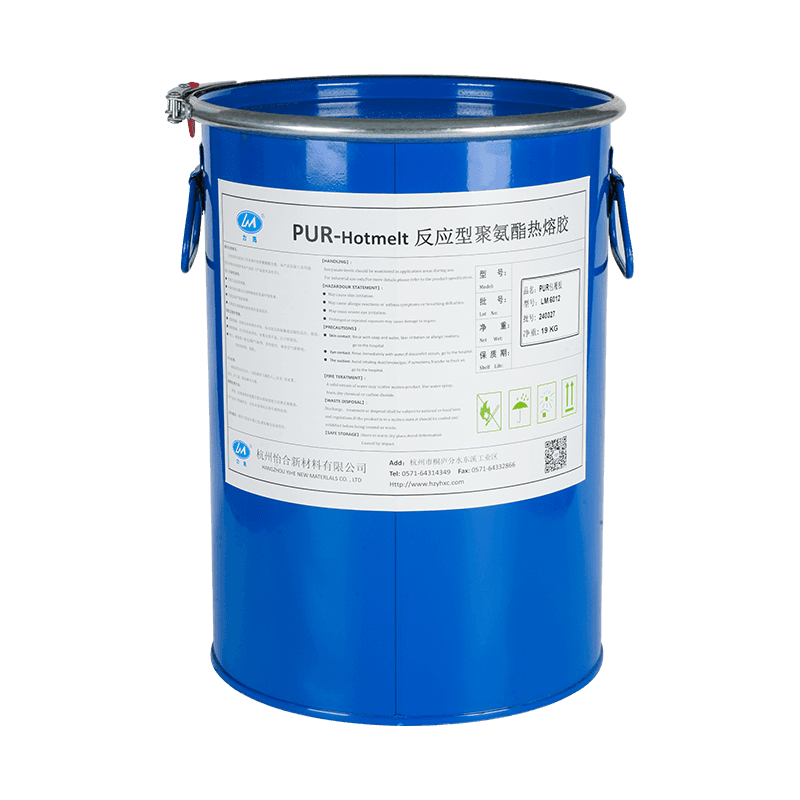
PUR wrapping hot melt adhesive bonds effectively to a wide range of substrates and foil materials, but compatibility is not universal — certain substrate surface conditions and foil types require specific adhesive grades or surface preparation to achieve reliable bond performance.
MDF, HDF, and particle board are the most common substrates in furniture profile wrapping, and PUR hot melt bonds reliably to these materials when the surface is clean, dry, and free from sanding dust or release agent contamination. Moisture content of the substrate is important — very dry MDF (below 5% moisture content) may bond acceptably but provides less moisture for the PUR cure reaction at the interface; very wet substrates above 10% moisture content can cause foaming or adhesive degradation. Solid wood substrates with oily or resinous species — teak, iroko, and some tropical hardwoods — may require surface cleaning or priming for reliable PUR adhesion. Aluminium and other metal profiles for architectural wrapping bond well to PUR hot melt after appropriate surface preparation — typically degreasing and optionally a thin primer — but the lower porosity of metal compared to MDF requires closer attention to adhesive spread weight and open time to ensure adequate foil bonding before the adhesive solidifies.
PVC foils are the most widely wrapped decorative material and are fully compatible with PUR wrapping adhesive. The crosslinked PUR bond is specifically advantaged over EVA with plasticised PVC because it resists the plasticiser migration that softens EVA bonds and causes PVC foils to delaminate progressively over time. Paper-backed foils and decorative papers bond readily to PUR hot melt and benefit from the lower application temperature of some PUR grades compared to EVA, which reduces the risk of paper distortion or colour change during wrapping. Veneer — real wood veneer or reconstructed wood veneer — can be challenging for PUR wrapping because veneer is hygroscopic and can absorb moisture unevenly, causing waviness or telegraphing of the adhesive layer through the thin veneer face. Adhesive grades specifically formulated for veneer wrapping with optimised open time and viscosity profiles are available from most major PUR adhesive manufacturers. Polyolefin and PP foils have low surface energy and typically require corona treatment or flame treatment before PUR wrapping adhesive will achieve reliable adhesion.
PUR wrapping hot melt adhesive cannot be processed in standard EVA hot melt equipment without modification or dedicated PUR-compatible systems. The reactive chemistry of PUR creates specific equipment requirements that must be met to achieve reliable adhesive application and to protect the equipment from moisture-induced curing within the system.
The most critical equipment requirement for PUR hot melt is exclusion of atmospheric moisture from the adhesive melt tank and delivery system. Any moisture contact with the molten PUR causes the free isocyanate groups to react prematurely, generating carbon dioxide that creates foam and bubbles in the adhesive, and eventually causing the adhesive to gel and solidify within the equipment — a condition that may require complete equipment disassembly and cleaning or component replacement to resolve. PUR application systems use sealed melting tanks with desiccant filters on the tank vent, nitrogen blanketing of the melt surface in some systems, and moisture-tight connections throughout the adhesive delivery path from tank to application nozzle or roller. Standard EVA melt tanks with open loading ports and unsealed vents are incompatible with PUR chemistry.
PUR wrapping adhesive is applied to the substrate by slot die nozzles, heated roller coaters, or spray application depending on the machine type and substrate geometry. Slot die application produces a uniform adhesive bead or film of controlled width and thickness and is the standard for flat panel lamination and many profile wrapping applications. Roller coaters apply adhesive over a wider area and are suitable for full-face application on flat substrates and simple profiles. All application system components — nozzles, rollers, hoses, and pumps — must be rated for PUR service and must be kept sealed from moisture when not in use. Cleaning between production runs uses dedicated PUR cleaner — typically a reactive solvent-based product or a clean-out EVA — applied while the system is still hot, followed by a purge cycle to displace all residual PUR before it can cure in the system.
PUR hot melt adhesive has a finite pot life — the time it can remain in the heated application system in contact with residual moisture from the environment before viscosity increases to an unworkable level. Pot life at application temperature is typically 4 to 8 hours for most wrapping grade PUR adhesives, though premium grades with extended pot life (8 to 12 hours) are available for operations with long production runs or frequent stoppages. Production planning should avoid loading more adhesive than will be consumed within the rated pot life. At the end of each production run or before extended machine stoppages, the adhesive system should be cleaned out with PUR cleaner rather than leaving adhesive in the system to degrade overnight.
PUR wrapping hot melt adhesives contain or generate during processing substances that require specific storage conditions, operator safety controls, and regulatory awareness. These requirements are not exceptional but must be understood and managed correctly in a production environment.
With a range of PUR wrapping adhesives available from suppliers including Henkel, Jowat, H.B. Fuller, Kleiberit, and Beardow Adams, selecting the most appropriate product requires matching the adhesive properties to the specific demands of the wrapping process, substrate, foil, and end-use environment. The following structured approach covers the key decision points:




Copyright © Hangzhou Yihe New Materials Co., Ltd. Rights Reserved.
Eco Friendly Glue Suppliers