English
 中文简体
 русский
 عربى
News
Home / News / Industry News / Polyurethane Reactive Hot Melt Adhesive: A Practical Guide for Manufacturers
 Search
 +86 178 5710 2305


Walk through almost any panel, door or furniture plant today and you will find at least one line running polyurethane reactive hot melt adhesive. It has quietly become the default choice wherever a bond has to survive heat, humidity and years of service, and where a water-based glue simply cannot carry the load.
We have spent a long time helping manufacturers get these systems running, and the pattern is nearly always the same: the chemistry is sound, but the process was never set up for it. What follows covers what reactive PUR actually is, how it cures, where it earns its place, and how to choose a grade that suits your line rather than fighting it.
Content
Reactive PUR is a solvent-free, 100% solids adhesive. At room temperature it is a hard solid; you melt it in a heated tank or drum, usually somewhere around 110 to 130 degrees Celsius, and apply it as a thin film while it is still fluid. On cooling it sets within seconds to minutes, which gives you handling strength almost immediately, the same speed advantage that made EVA hot melts so popular.
The difference begins after that. An EVA hot melt stays thermoplastic forever: warm it and it softens, load it and it creeps. A reactive PUR contains isocyanate-terminated prepolymer chains that react with moisture and build a crosslinked thermoset network. Once that cure is complete, the glue line will not re-melt, and its resistance to heat, water, steam and plasticiser migration sits in a different league altogether.
The cure happens in two stages, and blending them together causes most of the confusion we see on the shop floor.
The melt cools and crystallises, producing a bond strong enough to trim, stack, machine and move down the line. At this point the adhesive is solidified, not yet cured.
Over the following hours and days, moisture from the air and from the substrate diffuses into the glue line and reacts with the free isocyanate groups. Molecular weight climbs, the network tightens, and heat and moisture resistance rise with it. Full cure usually lands somewhere between 24 and 72 hours, and it is not a straight line.
Several things slow that second stage down: a dry winter workshop below 40% relative humidity, substrates stored bone dry, thick glue lines, and non-porous facings that block moisture from one side. None of these are failures of the adhesive, but they do mean quality checks should follow the real cure curve instead of testing a panel half an hour off the line.
If a bond has to hold under heat or moisture, reactive PUR is usually the simplest answer. Typical work includes:
| Property | EVA hot melt | Water-based adhesive | Reactive PUR |
|---|---|---|---|
| Solids content | 100% | 40 to 60% in water | 100% |
| Bond formation | Cooling only | Water evaporation | Cooling, then moisture cure |
| Heat resistance | Limited, re-softens | Moderate to good | High after full cure |
| Water and steam | Poor to moderate | Depends on polymer | Good to excellent |
| Open time | Very short | Long | Short to moderate |
| Typical use | Edge banding, cartons | Vacuum forming, lamination | Lamination, wrapping, edge banding |
Reactive PUR is not one product. Viscosity, open time, filler level and cure speed are tuned for specific processes, and running a wrapping grade on an edge bander will disappoint you no matter how carefully the temperature is set.
Laminating PET or PP film onto MDF is where film thickness control matters most. A moisture-curing flat lamination grade should flow out evenly under the nip, wet the film without starving the joint, and stay flexible enough to absorb the different thermal expansion of film and board.
 LM6016 PUR Hot-Melt for Flat Film LaminationMoisture-curing PUR with high initial strength and heat/water resistance for PET or PP film lamination on MDF, supporting controlled nip flow.View Product →
Wrapping puts the adhesive through a short, sharp deformation. The grade needs enough green strength to hold the profile around a tight radius without spring-back, and enough open time that a brief line stop does not ruin the run.
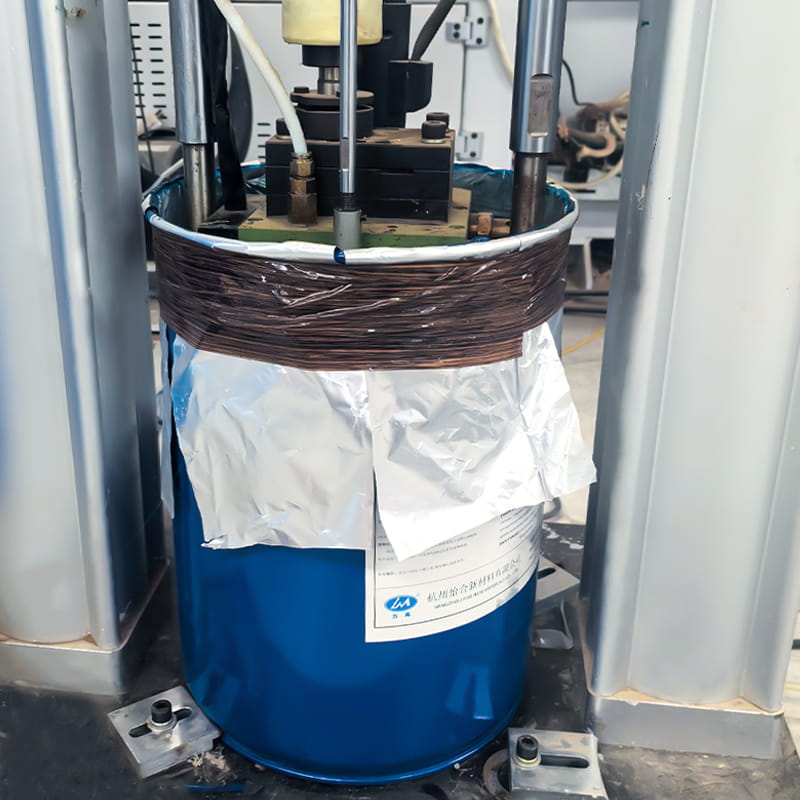 LM6012 PUR Hot-Melt for PVC Wrapping and Profile BondingSolvent-free moisture-curing PUR with high initial tack and heat/water resistance for PVC wrapping onto MDF, wood, wood-plastic and aluminum profiles, with moderate open time.View Product →
Doors and furniture panels are where PUR edge banding shows its value: no re-softening in a hot car, no glue line creeping open after a few summers. The trick is matching coat weight to band thickness rather than running heavy to feel safe.
 LM6019 General-Purpose PUR Hot-Melt for EdgebandingMoisture-curing reactive PUR with high initial strength and heat/water resistance for PVC edgebanding and wood substrate lamination, offering short curing and low-temperature adaptability.View Product →
Cold-press assembly, where no heat is available at the joint, is a different case again and calls for a liquid PUR rather than a reactive hot melt.
We have been making adhesives since 1997, when the company started out as a specialty adhesive plant on the banks of the Fuchun River. Our PUR hot melt range grew out of the same practical work: the lab looks at film wetting, green strength and cure behaviour, and the application team spends real time on customers' lines rather than only in the sample room. You can explore the PUR hot melt range to see how the grades are grouped by process.
If you are evaluating reactive PUR for a new line, or replacing a system that never quite behaved, tell us the substrate, the machine and the line speed. That is usually enough for us to point you in the right direction before a single drum is ordered. Talk to our technical team when you are ready.
Reactive PUR rewards a little preparation. Get the temperature, coat weight and moisture balance right, give the bond the time it needs to cure, and it will quietly outlast almost anything else on the market. Get them wrong, and it will remind you every shift.








Copyright © Hangzhou Yihe New Materials Co., Ltd. Rights Reserved.
Eco Friendly Glue Suppliers